Analysis, Storytelling Geekery

Blake Snyder’s Beat Sheet – Planet of the Apes (1968)

Blake Snyder wrote an influential plotting guide, Save The Cat, which contains his famous Beat Sheet.
Tim Stout, himself a writer of a how-to guide on writing graphic novels, has put a condensed version of the Beat Sheet up on his blog, and I’m going to quote the whole thing:

Continue reading “Blake Snyder’s Beat Sheet – Planet of the Apes (1968)”

Analysis, Storytelling Geekery

Story Structure

Amongst the ways you can divide fiction writers are the division between those who like to plan their stories out beforehand, and those who like to make things up as they go along.
George RR Martin, the writer of the Song of Ice and Fire books which have recently been turned into the excellent Game of Thrones television series, describes this division as being between Architects and Gardeners.
The Architect plans things out in detail before starting, while the Gardener enjoys waiting to see what things look like, then decide where things will go.

A writer of Ice and Fire. And a Gardener, surprisingly.

It’s easy to see Architect writing style as stiff and uncreative. I’ve read writers who’d probably describe themselves as Gardeners who say that a lot of the fun of writing is seeing where the story will take them.
But when I try to write in this style, I either regret the choices I take with the story, or end up spending ages setting up a relationship or describing the working environment, or introducing the hero and villain, with no solid idea of what they’ll come into conflict over.
I’d definitely describe myself as an Architect.

As a result, I’m fascinated by story structure. I’m sure there’ll be people who see structure as the death of creativity. I’m pretty confident there’ll be some big name screenwriters of the 70s and 80s who see the arguments put forward by Robert McKee and similar prescriptivists as being responsible for the lack of creativity in modern blockbusters. (The truth is, of course, that it’s entirely Michael Bay’s fault.)

Having said that, he does do a pretty good impression of a tidal wave.

The best way I know of to achieve this is a term I’ve only heard of in the last year, ‘breaking the story’.
In essence, you start with the story that you want to tell. That could be a story from your own childhood, something in the news that struck you as fascinating, or just a bunch of characters you want to play around with.
You then ‘break the story’ to get across the things you want to say, the jokes you want to tell, in the best possible way. Story structures, if they work, are rough rules for when things should happen.

I’ll start with a really basic story structure, which you’re probably already aware of – the three-act structure.
In basic terms, the first act is where characters are introduced and a conflict arises. In the second act, things get worse and tensions rise, and the third act is where the finale and ending occur.
That probably sounds really obvious – if you’ve ever seen a film, read a book, or told a joke, you basically know all that. But I just used a basic example to demonstrate that structure and creativity aren’t necessarily opposed.

Anyway, the point of all this, is that one thing I intend to do more of soon is to reverse engineer existing stories, look at how others have approached the idea of structure.
I’ll look at Blake Snyder’s 15-part Beat Sheet & Dan Harmon’s Circles soon, and others not long after.
I’ve done a little of this before (though not on the blog) and I find it both interesting and useful to look at how other writers have structured their stories. So if anyone else reading this wants to join in and link to their own reverse-engineered story plans I’d be interested to take a look.

Analysis, Film & Television Opinion, Review

Citizen Khan – Some Thoughts on the BBC’s Offensively Bland New Sitcom

Last Monday saw the first episode of Citizen Khan, the BBC’s first Muslim family sitcom, and, well, it’s not been well received. There have been claims the programme is offensive to Islam, that it stereotypes Muslims, and, most fundamentally of all, that it simply isn’t funny.
I’ve now watched the first episode all the way through twice (which appears to be roughly 4-12 times as much as the average person who sat down to watch it), and tried to set down some thoughts about the programme.
What follows is part review, part analysis and partially a look at the social implications of the show. (I’ll try to prevent it from being too pretentious, I promise.)
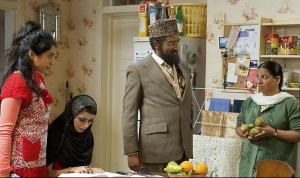
To start with, I’ll say that I’m not a fan of Miranda, another BBC sitcom that seems to be aiming for a similar ‘retro’ feel as Citizen Khan. Though I love Dad’s Army, Morecambe & Wise and have generally positive feelings towards ‘Allo ‘Allo, I’m probably not the ideal viewer to target with this kind of ‘big’ humour.
But even so, there’s a lot in the first episode that could be improved without driving off the target audience.

To get something out of the way first, there’s a few cultural references that I didn’t get. Citizen Khan is a character spun off from a sketch show, Bellamy’s People (and the character had appeared as a radio character before that). In Bellamy’s People, a TV host travels round the country meeting with a cross-section of British people for a ‘documentary’. He meets Mr. Khan, who describes himself as a ‘community leader’ despite not seeming to have a lot of respect from the locals. Similarly, in Citizen Khan there are jokes that play off the settee being covered in plastic, and Khan bringing in a large bag full of toilet rolls, which, judging by the reaction on Twitter, seems to be a real cultural trait amongst British Muslims. These are jokes that didn’t connect with me, but that’s fine, not every joke is going to land with everyone.

But beyond that, the show is full of predictable, obvious ideas, and decent ideas really badly executed. It might seem paranoid and reactionary to say that if this programme didn’t star a Muslim family, then it wouldn’t have been made. But it does seem that the people making Citizen Khan got carried away with the idea of making a show centred around a Muslim family, and were blinded to the flaws.
For instance, in one scene Khan sits at his desk within the mosque, and for some reason starts singing into the turned off microphone. it never feels real, like a person relaxing and being silly, but like a performer doing something wacky for the sake of it. And then, in a massive twist, it turns out that the microphone was turned on the whole time!!
At another point Mr. Khan is told that his family is considered common, which he responds to by asking why, then hocks his throat as if he’s about to spit.
It just feels so, so, fake – artificial situations set up purely for a joke, but too predictable to land a laugh, rather than creating situations which are inherently funny.

And Khan himself… Well, he’s a self-indulgent anti-hero of a patriarch, so I think the best models of comparison, for good and bad, are Homer Simpson.
In the early years of The Simpsons, Homer is an idiot, and a self-indulgent jerk, but he means well and tries hard to fix the messes he accidentally causes.
Homer dances with a bellydancer on a stag night, and fails to get Lisa a new reed for her saxophone in time for a performance, but always means well, taking a second job to earn back Lisa’s love in the second of those two episodes.
Then, in later years he morphs into what’s been called Jerkass Homer – a character who causes disruption for others, yet faces no consequences himself, blindly riding off to cause more mess without any punishment.
I think the creators of the show wanted Khan to fit into the first model – he forgets that he needed to book his eldest daughter Shazia’s wedding at the local mosque, a classic ‘early Homer’ mistake (religion aside). But in the process of trying to fix or hide his mistake, he tries to bully the mosque manager into giving him what he wants, then places the blame on his future son-in-law, which leads to the pair breaking up.
Khan does eventually go to Shazia to beg her forgiveness, but he seems happy for his daughter to lose the love of her life, just as long as he doesn’t get the blame.

As well as this…well, I’m pretty sure Mr Khan is racist.
He seems to think ginger and Scottish are the same thing, and insists he can’t be racist as he’s from a minority – well there’s definitely potential for humour there, and I’m sure some people laughed, so I won’t dwell on that.
Khan meets his friend Riaz outside the mosque, who introduces his new employee, Omar. Omar greets Khan cheerfully, and Khan then turns round to whisper to Riaz:

Khan: “What’s wrong with him?”
Riaz: “He’s from Somalia.”
Khan: “Oh!”

Apart from a slightly strange pronunciation (I doubt it’s a completely accurate Somalian accent) there’s nothing OTT or unusual in the way Omar speaks or acts, so I’m genuinely confused as to what Khan’s commenting on. And if it’s Omar’s accent Khan’s laughing at, doesn’t that make him racist? Omar is played by Felix Dexter, an excellent actor in a minor role, who I’m sure could have pulled off whatever was asked of him. Was the joke genuinely meant to be that foreigners with strange accents are funny and should be laughed at? I’m honestly unsure what they were going for with this.

Aside from Mr Khan, I counted seven other significant characters in the first episode (plus two – Riaz and Omar – who appeared very briefly). Of those seven, five can be described totally by a very brief handle – The White Convert; The Timid Idiot; The Fierce Mother-in-law; The Partygirl; The Middle-Aged Maneater – while the other two, I have trouble even describing in that much detail. The Houseproud Mother and The Nice Daughter perhaps? I can’t think of anything any of those seven characters do that contradict or add complexity to those very brief and narrow descriptions.

And the whole show is over-acted. It seems almost like a parody of acting, with every joke and emotional beat being struck as hard as possible.
Adil Ray as Mr Khan is the worst – the scenes in his office come across, as I’ve said, more as a performer doing something wacky than a character intended to be mistaken for a human being. The character has been transferred from radio and sketch comedy, where a bigger performance is appropriate, without adapting the performance to fit. In fact, it feels like the rest of the cast were instructed to rise to his level of melodrama, rather than bringing it down, rooting it in something human, identifiable.
The reactions to the family being told the mosque hadn’t been booked are so over the top that I was left wondering why I’m supposed to care about these hysterical idiots.
In addition, the characters are incredibly unperceptive – I buy Mr Khan thinking that his partygirl youngest daughter Alia is as devout as she claims, as she seems to have him wrapped round her finger, but her mother seems like she should see through the act. And Shazia, the eldest of the two daughters and supposedly pretty smart, is meant to have bought her father’s blatant lie that her fiancée is responsible for the mosque not being booked.
Families, by nature of spending time together, get to know each other pretty well, but no-one seems to know anything about each other in the Khan family.
Kris Marshall plays the mosque manager, a white convert to Islam, and seems to be the only member of the cast who wasn’t told they were supposed to play every joke, every emotional moment, as over the top and obvious as possible, pandering to the most slow-witted members of the audience.
Yes, the idiot son in My Family is the only member of the cast who seems capable of understatement.

It’s a shame, as I think there were genuinely some good jokes in there, hindered by the mess around them.
Going by my notes, I was amused eight times (seven of them where the joke seemed deliberate).
In one, Khan asks if anyone saw News at Ten the previous night, adding

“Seven times they mentioned Pakistan! Twice in a good way!”

I’m not from an immigrant family myself, but this felt ‘true’ – it felt like this was a believable reaction from an immigrant with pride in his country of origin so strong it sort of overrides logic.
This, to my mind at least, is how sitcoms should work – believable characters with a range of character traits, some of them comic.

I mentioned that one time I laughed when the joke didn’t seem deliberate. Late in the episode, when Shazia and her fiancée are separated, she’s laid in a foetal position on her bed, clearly distraught, in a room with pink bed sheets and pink lamps, wearing cuddly bear slippers and clutching a pink fluffy toy. All of this is clearly meant to convey that she’s a soft, delicate young woman, and set the stage for the emotional heart of the story (Khan apologising to Shazia) but it’s expressed in such over the top stereotypical way that it made me laugh.

I didn’t dislike Citizen Khan in the same way I do Miranda or Mrs Brown’s Boys – it’s surreal in a way I couldn’t quite believe or understand. I watched it with a sense of confusion, bewilderment about where they were going with certain plot elements, and how things had managed to turn out this bad without someone slowing down production to fix its problems.
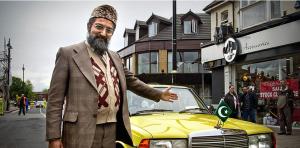
Onto the reaction.
The BBC had received 185 complaints by the time they put out an online article on the reaction less than two full days after transmission, Citizen Khan was covered in opinion pieces in The Telegraph, The Daily Mail, The Guardian, The Huffington Post
and was described as “outdated…lazy and offensive” in The Independent.

Two of the main lines of criticism (besides the show not being funny) were that it mocked Islam, and negatively stereotyped Muslims.

Firstly, there’s a difference between poking fun at one aspect of religious culture and mocking the religion itself.
To return to The Simpsons, there’s an episode where, after getting home from church on a Sunday, Bart and Lisa throw off their Sunday best clothes in celebration, with Bart explaining that it’s the part of the week that’s furthest away from having to go to church.
That line isn’t mocking Christianity itself – it’s a lot different from a section that argues that there’s no God and that everyone who attends church is an idiot – but gently teasing about one aspect of religious culture that does happen in the real world.
The ‘controversial’ aspects of Citizen Khan – the idea of a party girl daughter pretending to be devout for instance – fit into the same mould.

As for the stereotyping…
Stereotyping, can be used for comic purposes by playing off the audience’s expectations. Think of the Indian friends ‘going for an English’ in Goodness Gracious Me. The sketch takes the way many English people misunderstand Indian food, and turns it on its head. By using commonly held stereotypes, the creators were able to start with a basic set of shared ideas that they could safely assume the audience as a whole were aware of.
Stereotyping can also be used to reduce a group to something small, and limiting, whether purposeful or not. (Black people are good at athletics and join gangs; Asians are religiously devout and keep to themselves; the Irish are humorous and drink a lot, etc.) Stereotypes say that this is who your culture is, and since you’re from this culture, this MUST also apply to you.
The characters (Mr Khan aside) are underdeveloped stereotypes, but I’d say they’re more sitcom family stereotypes than Muslim stereotypes.

A sitcom, as opposed to a sketch show, should go beyond the stereotype, to something individual to that character. To return to The Simpsons one last time (because there really is no better programme to compare against) Homer is a loudmouthed idiot, but he’s also a sensitive soul who wants to look after his family. Lisa is a borderline child genius, but she also has a sense of melancholy that she only feels able to express through blues music. The characters are stereotypical enough to be recognisable, yes, but they have depth and complexity that makes them feel human.
Citizen Khan is only one episode in, so it may well develop a greater character complexity. I’m sort of cautiously optimistic about Alia developing into an interesting character. But there was enough time to devote to basic character development in the first episode, rather than show how hilariously wacky Mr Khan is.

I apologise if I’m wrong here, but I think most Asian families in Britain have immigrated within three or four generations, so the majority will know a relative who was raised in their old country, and will still be going through the process of adaptation. There’ll be a tension over changes in the younger generations, as the Asian/Muslim community is growing into something new as they’re exposed to wider British culture, either degenerating into something tacky, or evolving into something that combines the best of both.

Citizen Khan, as deeply flawed as it was, put me in touch with some cultural traits within the British Muslim community that I didn’t know about, and gained an ever so slightly deeper understanding of the ways in which we are different and similar. A programme of this type, if well executed, can build the sense that Muslims are part of ‘us’ rather than ‘them’. Think of programmes like The Kumars and Goodness Gracious Me, gently mocking both British Asian habits, and wider British culture.
But by far the most offensive thing about Citizen Khan is that it wastes the audience’s time on something that simply isn’t funny.

Citizen Khan is available on BBC iPlayer, episode 2 is on BBC One at 10:35 Monday September 3rd.

Review

The Devil Rides Out by Dennis Wheatley

The Devil Rides Out is a story of Satanic worship in upper class 1930s Britain.
Wheatley was a very prolific writer, and Devil is drawn from his Modern Musketeers strand. The titular musketeers are 4 friends – the elderly French exile De Richelau, the American adventurer Rex van Ryn, family man Richard and supernaturally curious Simon.

The characters are colourful but not that complex. Going back to the original Three Musketeers, Aramis wasn’t that good a fighter, and was waiting for his opportunity to join the priesthood; one of the others had a secret past that was slowly unveiled. They’re surprising and contradictory in ways that draw you in, make you want to learn more about them. In addition, there’s not much in the way of inner desires – D’Artagnan wanted to prove himself, Aramis to reconcile his womanising and desire to become a priest, but there’s not much of that here.
Having said that, the characters are easy to tell apart, ‘iconic’  and recognisable in their own ways, but lack depth and interesting contradictions within their characters.
The Devil Rides Out has no real mystery, though clearly by design – within about three or four chapters
Action stories (film, television or prose) tend to have action and mystery, a chain of dramatic events, each leading to the next, but also a mystery. Who’s involved, what are they doing, how deep does it go. There’s none of that here – you can tell from early on roughly how it would end, and who’d be involved in the climax.

Devil_Worship.                               Taken from Wikimedia Commons

The magic, black and white (or ‘right hand’ and ‘left hand’ paths) feels real – it goes beyond the stereotypical trappings of magic – eye of newt and so on – and feels like a system of magic that could have grown up over time, that has it’s internal consistencies that make sense on their own terms.
The Devil Rides Out is a ‘smart’ action adventure – the antithesis of something Michael Bay would produce.

The characters share a love of food – there’s beautiful descriptions of various meals, and the four Modern Musketeers seem to regard taking a light evening meal free from meat (something to do with sharpening the mind for the use of white magic) as a kind of torture. At one point, two characters are searching through a mansion trying to rescue a third. They may or may not be alone, and magic has been performed recently, but stop to make themselves sandwiches  from the buffet they left. It threw me at first, but it’s the kind of strangeness that adds detail and quirk to the characters

There’s not enough tension or mystery to make the story as compelling as I’d like it to be. It’s a bit hard to put my finger on the problem – the action moves pretty fast, the ‘rules’ of magic are believable, and the characters were interesting enough to make me care about them. But I didn’t feel the kind of compulsion to race back to the book in the same way I did with Reacher and The Hunger Games – it’s almost a matter of being worried that the protagonists will be okay, but with Devil, I didn’t feel for them.

Writing this review made me think about rules particular to the action genre. I’m a fan of the Jack Reacher books, and I’ve this year read the first two Hunger Games books. In The Hunger Games, it’s obvious the main character isn’t going to die in the middle of the book (partially as she’s the narrator) but there’s always the belief that other, well-developed and likeable characters will die, and horrifically.
With the Modern Musketeers being in a series of books, it feels a little like when watching an ongoing TV programme – they won’t kill him, he’s a main character – and they won’t change dramatically over the course of the story either.
The Devil Rides Out is over-written compared to them, and slows the speed of the action. It’s fine for Dickens to spend time describing the appearance of a person or building, but in an action novel, the story needs to move more swiftly than Devil does.
Each chapter with a cliffhanger, and I think they were pretty much all interesting ones, there is still a lot to enjoy here. Despite how it may seem above, I enjoyed the book, but I wasn’t totally gripped by it.
The Devil Rides Out is a derring do/boy’s own adventure, fantastical and escapist, and while darkness and the possibility of failure would go against the point of what the writer wanted to achieve, the lack of real danger stops it from being a page turner.

Verdict: A well-written, well thought out action adventure, but which lacks mystery or tension.

Review

Heart of Darkness by Joseph Conrad

I’ve recently finished reading Heart of Darkness, Joseph Konrad’s novella set in late 19th century Africa, which inspired Apocalypse Now. I’m one of the few people who’ve not seen the film, so I won’t be able to make any comparisons – though there was a disappointingly low number of helicopter attacks.

Heart of Darkness in the Belgian Congo, where crews of various nationalities are working under the power of ‘the company’, who have established a more imperial than capitalist foothold.
The story begins with Charlie Marlowe on the banks of the Thames as night falls, telling the story that follows.
The blurb of my copy claims that Konrad inspired Orwell, Golding, Celine, Borges and Eliot. Being a bit of a philistine, Orwell is the only of those I’ve read, but the writers that came more to mind as I was reading were JG Ballard and Joseph Heller. Ballard’s novels use strange worlds and situations to look at what happens to seemingly civilised people when taken out of civilisation. Heart of Darkness reminded me in particular of The Drowned World, set in a London that’s became a post-apocalyptic swamp. As for the comparisons to Heller – the company appears to be a beauracratic mess. A specialist and highly skilled brickmaker is sent where there are no materials for him to work with, and when a ship runs aground and rivulets are needed to repair it, Marlowe is able to get his hands on everything but. The comedy (or it might be better to call it cynicism) is played deadpan, as opposed to the sometimes zany tone of Catch 22, but there were a few moments that were sharply funny in the same way.

The main idea running through the novel is the effect the environment (the heat, humidity, distance from home) has on people – are they driven slightly mad, or are their true selves coming out? There’s grand talk of civilising the natives, but most of the characters don’t seem to think much of them, and there’s regular use of the ‘n word’. (No, I don’t mean native.) There’s an interesting comparison with Roman soldiers travelling to primitive and remote Britannia, far from their loved ones and what they considered civilisation, so the author clearly knows what he’s doing, rather than having ‘outdated’ views himself.

There isn’t a definite, clear narrative – the novel is more a series of things that happen. Whereas in Apocalypse Now, the hero is assigned to retrieve Kurtz near the start, the plot in Heart of Darkness develops in stages. It’s personal ambition, rather than orders, that take Charlie Marlowe to Congo. He spends time adapting to the environment (where he hears a series of whispers about the missing genius Mr Kurtz) before he is assigned to bring him back to Europe.

But the absence of a strong narrative works well for the book. The substance is  the taking apart of moral frameworks – imperial worldview of the company, Marlowe’s more subtle morality, and Kurtz’ grand ambitions.
All of this is told in prose that’s detailed and enveloping without being too rich, does a lot to build the feeling that Marlowe is feeling, of the Congo getting under the skin.

Verdict: A landmark and influential novella, with provocative ideas and a dash of cynical humour.

Review

Veronika Decides to Die by Paulo Coelho

I wasn’t optimistic about Veronika Decides to Die when I first picked it out. Paulo Coehlo is a name I’m aware of vaguely, but I’d never read anything of his before I noticed Veronika on the shelf of a charity shop.
The blurb also gave me pause for thought:

Veronika has everything in life she could wish for – young and pretty, with plenty of attractive boyfriends, a steady job, a loving family. Yet Veronika is not happy and one winter’s morning she takes an overdose of sleeping pills, only to wake up some time later in the local hospital. There she is told that her heart is now irreparably damaged and she has only a few days to live…
Through these intense days Veronika comes to realise that every second of existence is a choice we all make between living and dying. This is a moving and uplifting song to life, one that reminds us that every moment  in our lives is special and precious.

While others may disagree, to me that sounds like a routine, by the numbers, ‘heartwarming’ story, in which the hero discovers the joy of life, realises there are things worth experiencing, opens her heart, instantly embraces joy, skydives from a plane, blablabla.
It’s not that I disagree with that sort of outlook on life, but in my experience it’s usually handled badly – superficially and cleanly. If I am cynical about ‘heartwarming’ stories, it’s only because it’s a story format that’s hard to pull off in my experience. Its more likely to end up cheesy and sickly sweet, rather than upbeat and optimistic as they’re intended to be.
And Veronika Decides To Die does pull this off – it’s a genuinely sweet book, with the sharp edges – dealing with subjects like misery, mental illness, the difficulty of connecting with others – intact.

Paulo Coelho: You may remember him from such poses as ‘stroking his beard’ and ‘resting his head against his left hand’.

I really like ‘magical realism’ as a style of prose – the type of world that feels more real than reality, a bigger, quirkier and more colourful version of the real world, but still rooted in the complex and sometimes dark emotions of the world around us.
This is achieved partially by the colour and poetry of the prose, and partially with playful ideas – there’s Veronika’s suicide note, Coehlo writes himself into the novel, and one of the doctors believes he’s found a single cause of all madness (one that isn’t totally implausible).

The story begins with the main character, Veronika, deciding on suicide, not because she’s been worn down and is unable to cope with life, but because, on a more intellectual than emotional level feels her life is pointless. It’s an interesting choice for the writer to make, as is the whimsical way the scene plays out – considering placing the blame for her suicide on a magazine article that was mildly rude about Slovenia, her home country.
As mentioned in the blurb, Veronika’s suicide attempt fails, leaving her, weeks from an inevitable death, in a mental institute. But she doesn’t open up straight away – the opposite in fact, shutting down and withdrawing from those around her, so as few people are hurt by her death as possible.
The book takes a long time for the positivity I was expecting to kick in – not only is Veronika consistently negative, but it’s persuasive, logical negativity as well.

As Veronika embraces her loneliness, the scope of the story expands, showing us the patients of the institute, with conditions ranging from anxiety to schizophrenia, and the characters are well drawn, sympathetic and believable.
Having said that, none of the characters are given mental illnesses that place them into an unwinnable situation, and I’m not sure schizophrenia works the way it’s depicted here.
There’s also an event towards the end of the story I found hard to buy, but by the time I reached it, the book had built up enough goodwill, through its tenderness, humour and depth, that I was willing to set my objection aside.

Verdict: A genuinely inspiring and empathic novel, with tenderness and sympathy for it’s flawed characters.

Review

Review: Dead Boss, episodes 1 & 2

Dead Boss is the new sitcom cowritten by and starring Sharon Horgan (Pulling, Annually Retentive, Todd Margaret), and is a darkish comedy with quite a cheerful tone.
The first episode opens in court, after Helen Stephens (Horgan) has just been found guilty of murdering her boss. Some quick exposition lets the audience in on the plot, and the subtext of what’s really going on, as she’s sentenced and led away.

Dead Boss is silly enough to make light of the dark subject (complete with cheerfully upbeat narration and music), but dark enough that interactions with Top Dog and Yvonne (leaders of the prison gang) have menace to them.
There’s a strong story running through the comedy, whereas Life’s Too Short, for instance, is more a series of comic incidents with a plot loosely connecting them. With the process of appeals, and the murder mystery, there’s a strong story here as well as the comic incidents.

But of course, comedies rely on the quality of their jokes, and Dead Boss is packed with good lines, many of them laugh out loud and mostly character based. Some of the jokes are a bit filthy (Horgan was one of the writers on Monkey Dust) but Dead Boss doesn’t reach for the cheap shocks.

Though you may expect a writer-star to give themselves the best lines, there’s a range of strong characters here – Helen’s meek, arsonist cellmate, her cheerfully indifferent sister, Jennifer Saunders as The Governor – almost as selfishly detached and delusional as Absolutely Fabulous‘ Eddy Monsoon – and a cheerfully incompetent lawyer, who announces that ‘Until I get paid, my work will be half-arsed. At best.’

The best comparison I can make on Dead Boss‘ style is with 30 Rock.
I first became aware of 30 Rock by repuation, a fair while before seeing an episode. With it being hyped up so much, I expected something very funny and emotionally and tonally realistic, like Frasier and Cheers at their peaks. In fact, it’s more like Airplane – very funny, but in a silly and inconsequential way, with characters that are quite over the top. Dead Boss is the same.
Dead Boss has the kind of world that isn’t realistic, (and certainly wouldn’t be mistaken for a documentary as The Office apparently was) but has plenty of funny and compelling characters. None of the characters is a Tracy Jordan or Jack Donaghy, but there are a few (Aisling Bea’s and Edward Hogg’s characters in particular) who are just below that level in quality.

Verdict:
Silly but involving ensemble sitcom with colourful characters and big laughs.

Dead Boss is available on BBC iPlayer, episode 3 is on BBC Three at 10:30 Thursday.

Analysis

The Opening Scene of Friends

When I first started this blog, one of my initial aims was to analyse, to look at films and television from an analytical point of view, to tear things apart and look at why they do, or don’t, work.

As part of the process, I’ve looked at a few pilots, in particular how they introduce the characters, to take some tips for my own script.
In particular, the opening scene of Friends is, in my opinion, excellent. I’m not going to look at the quality of the jokes (I think that analysing humour tends to kill whatever was funny about the line or situation, and besides, that’s not really what interests me here) but at the way the characters are introduced.
First of all, I’d recommend you take a look at the video below, as it really is quite funny:

http://youtu.be/FaGIx2NHU2I

0:00 – 0:28 The episode (and the series) opens by introducing Central Perk coffee shop first, introducing the setting before the characters, and the sign on the window establishes that this is a coffee house.
Four of the main cast are discussing Monica’s pathetic love life, Joey mocking her while being smooth, Chandler quipping, Phoebe talking sympathetically about her ex-boyfriend’s chalk addiction.
Four of the main characters are fundamentally introduced here – Monica is pretty defensive and has romantic troubles, Phoebe is open-hearted and mixes with slightly weird people, Joey and Chandler are being smooth and quippy respectively, and to an extent playing off each other. Bear in mind that this is within the first twenty eight seconds of a brand new programme, and the audience should have a decent sense of who 67% of the main characters are already. That’s pretty efficient story-telling.
I just want to slow down for a second, and look at what we know about these characters based on just this very brief opening section.
Joey is cool, laid back, though the leather jacket is perhaps slightly overstating his character, making him seem a little bit more like Tony Danza than the character Joey Tribbiani would become.
Phoebe has her hair in pigtails (a girlish look) and is genuinely slightly weird, in a way that’s amusing and intriguing, rather than ‘look at me’ wackiness.
Chandler is quippy, with a fast-paced delivery, and Monica is more emotionally open and honest than the other characters, more open to mockery than doing the mocking.

0:28 – 1:00 The scene cuts forward to later, still at the cafe. Chandler is now telling the story of his dream, which is recognisable but… goes off in a weird direction.
And, while I may be reading a bit too much into the scene here, it also touches on the empathy of the series. The core audience was always, as far as I’m aware, people in their mid-twenties – similar people to the characters – just living a more glamourous and exciting life. It’s a slightly cheap trick, but introducing something – anything – that the audience can identify with, will help to build a bond between viewer and character. Also, Chandler’s dream condition sounds quite painful.

1:00 Ross enters, on the verge of collapsing into tears. Upset at his wife having left him, he’s being miserable and self-hating – hatred driven internally, rather than outward.
Joey’s line – ‘This guy says hello, I want to kill myself’ – shows that this is a group of friends willing to make jokes about even the misery they’re going through, suggesting a strong friendship, with no solid boundaries betwee them.
Concentrating on Ross’ behaviour for a moment, it’s striking how different his behaviour is here to in the later years of the series. His reaction to being left by the woman who had pledged to spend the rest of her life with him, makes him understandably miserable, but he doesn’t seem too angry about it.
Imagine if he acted in a different way. Imagine, to pick a totally random example, his ex-girlfriend, who dumped him after he slept with another woman several years earlier, pointed out that this hurt her, and he responded by, out of nowhere, yelling at her about how technically what he did was okay, because technically they hadn’t been a couple for about six hours when he slept with the other woman.
You wouldn’t like that guy, would you? Of course not, that guy’s a jerk, to put it mildly. So unless you have really bad taste in friends, you’d be annoyed by someone with such poor self-control and lack of perspective.
Here though, Ross, though clearly unhappy, has driven his anger inwards, he’s reluctant to even admit he’s angry at his ex-wife, who’s left him for someone else. The Ross – Rachel plot was the central driving narrative in the first few years. With Ross as the main protagonist of the series, establishing him as sympathetic and likeable early on is pretty important.

1:30 Combining my earlier points about Phoebe and Ross, trying to cheer Ross up, Pheobe ‘cleanses his aura’. Ross is clearly annoyed by it, but doesn’t get too worked up.
Ross doesn’t seem the type to believe in spirituality, but even at his emotionally lowest doesn’t snap at her, plus it helps establish Phoebe’s slightly weird personality a bit further.

1:44 Joey: ‘And you never knew she was a lesbian?’ Ross: ‘Why does everyone fixate on that?’
First of all, it’s a really funny line.
I’m not totally aware of the state of gay acceptance in mid-nineties New York. (In my defence, I was a kid living 300 miles away.) But I’ve read references to Ellen’s ‘coming out’ episode as being a major landmark in gay culture, and that came in 1997, three years after this episode was aired.  The idea plays up the metropolitan, colourful nature of New York, and, to an extent shows how nice a guy Ross is that this seems almost irrelevant to him. Though I’m not sure of the cultural context, it may have helped make the show seem edgy.
There were early plots centring around threesomes and being the other man in an open marriage. In the early years it was a little bit edgy, all things considered.

2:25 ‘I just want to be married again’, then Rachel shows up in a wedding dress. Chandler’s next line (‘And I just want a million dollars!’) shows his irreverence, and he’s mocking the show itself to an extent. I don’t want to get bogged down in how much the quality of the show dipped over time, but I’d say this acts as a sort of promise to the audience, that there’ll be big, interesting events happening in this and future episodes, but that the characters won’t take themselves too seriously.

2:50 Monica takes control when Rachel enters, introduces her to the other characters. This establishes that the two have the previous relationship, Monica’s position as the mother hen of the group, hammers home who the characters are (I don’t think Joey and Chandler were mentioned by name before this).
Having re-watched a few of the first few years of Friends in recent months, most of them in or just after the Tom Selleck era, I’ve started to realise how much Monica is the emotionally vulnerable mother hen of the group, the ‘heart’ of the story, so to speak. In the same way that Michael Bluth is the ‘normal’, relatable character in Arrested Development, surrounded by weirdos, I’d argue that Monica plays a similar role in the early years of Friends. If my memory’s accurate, this only goes as far as series 4 or 5, before the gang start to deviate from their ‘classic’ personas, and become less funny, less interesting characters, with their interesting and relatable quirks being replaced by melodrama and overacting. But in the early years, she is very much the mother hen, the characters who feels, and creates, the most empathy.
Over time she becomes an uptight weirdo, with an OCD problem that would concern Adrian Monk, and I’m not sure that Courtney Cox has ever been particularly funny. But, as much as the friends clearly care for each other, she goes further than the others in the early years in creating empathy. Ross, with his divorce and feelings for Rachel, is the central character plotwise in the first few years, but I’d argue that Monica is the emotional centre of the show.

3:10 Rachel tells her story – why she ran away from the wedding. She’s a bit scatterbrained in her explanation, but gives a good and compelling explanation of why she suddenly came to the realisation she couldn’t marry Barry.
She’s the last of the characters to be properly introduced, and as she’s coming into their lives, it makes sense to introduce the other five main characters – the status quo – first, and have Rachel’s introduction act as the inciting incident, the thing which shatters the status quo and spurs the story into action. As well as her own story, she has an impact on Monica (her old friend who invites her to share her flat) and Ross (who had an unrequited crush on her when younger). While these plotlines aren’t shown in the opening scene, she’s turned to Monica for help, and Ross is being supportive and helpful to her.


Looking in from a technical point of view, one of the things that surprised me was the quick cuts.
Rather than everything in the conversation following on in real time, the show cuts across the relevant points in a long conversation. This  shows they’re happy to spend a significant portion of time just sitting around in each other’s company, and is more realistic than having the ‘big events’ happen one after another.
I don’t think that I’ve seen this used too often in other sitcoms (or even in Friends) but it’s an interesting device.

Chandler’s material is weird, embarassing, witty but self-effacing.
Joey’s is smooth, he’s stylish in control. His cool is never really undercut, whereas Chandler would find it nearly impossible to build up a sense of cool after what we see of him here. Joey’s also a bit indifferent – whereas Ross goofily and clumsily tries to be supportive to Rachel, Joey just sits there, and makes fun of his goofiness.
Rachel is moving at 100 miles an hour, bit of a scatterbrain, a bit self-involved and spoiled. There’s an episode in one of the later years when Phoebe discovers Rachel had a lesbian affair in college, and is surprised by it, as Rachel is ‘so vanilla’. Eventually she develops this way, but at first she’s definitely a slightly spoiled and emotionally stunted brat, and this is the start of a personal quest for her, a process of personal growth.
Ross is miserable, but drives his frustration and anger against himself (as he’s not yet developed the sub-Adam Sandler anger management problem he’ll have in later years). He doesn’t lash out at his friends – even when he’s clearly a little bit annoyed by Phoebe, he’s still quite nice about it. He wants to wish the woman who’s just broken his heart well, and is being caring towards Rachel (pouring sugar into her coffee) when she tells her story.
Phoebe in later years becomes more generic Hollywood zany girl, as if the writers are thinking up wild and wacky things for her to, rather than look to the root of the character. Here she’s quirky, off-beat, but in a way that feels like a real person.
Monica, I’d say, really only has one funny line where the comedy rests on her performance (rather than being mocked by others). I don’t know if she was originally envisioned as the ‘straight man’ of the group, but she feels like she works that way here.

When a television programme is as well made as Friends was at it’s peak, it’s tempting, even as someone who wants to imitate it’s greatness, to sit back and enjoy, without thinking about why I enjoy it. But, even without looking at the jokes, I think it’s interesting how quickly and how well the characters are introduced here.

Basically those are my thoughts about the opening of Friends.
I’d be interested in reading any further thoughts people have to offer, whether building on what I’ve said or tearing apart my interpretations.

Read My Fiction

Don’t Tell Me to Be Quiet

I’ve been updating this blog irregularly for about half a year now, with a variety of subjects. I’ve dropped links to my articles on Born Offside, and rather silly spoof news on The Leaky Wiki, as well as a few reviews and analysis of books and television here, and off-format silliness that wouldn’t fit on The Leaky Wiki.

But despite being an asipring fiction writer, I’ve not actually put any fiction up yet. Partially this is because of not finishing things off, partially this is about not wanting to share small things that could be developed into something bigger and longer. But I intend to start putting up some short prose on here, for your reading pleasure as you wile away a few minutes on the weekend. I hope you enjoy…

Don’t Tell Me To Be Quiet

Joanie and Mitchell had been tossing and turning through the night, woken again and again by their beautiful young genius.
As new parents, they’d followed tradition, and taken it in turns to respond to the demands of the new life they’d created – this was the third time Mitchell had been called from his bed that night. He wished he was a more old-fashioned man, wished he was some sort of horrible old-school misogynist, who left all aspects of child-rearing to his wife. He wasn’t a bad man – at least he didn’t think so – he just wanted sleep.

Already, nine days after birth, Precious Symphony Polyphonic Jones was progressing faster than the books said she should. Mitchell was sure he’d heard her say ‘ma’ the other day, but it could have been a belch.

Mitchell held his armful of joy, whispering to her in a cheerful tone.
“Who’s a special girl? You are! Yes you are!”
Holding her tightly, he swung round, hoping the motion would relax her. It was a sort of a centrifugal effect, with Precious pressed tightly against his body, in an intimate grip.
“You’re going to do something amazing with your life, because you’re my indigo princess, aren’t you? Aren’t you, sweetie?”
Mitchell was tempted to say something really awful, something he knew he shouldn’t.
“But if you’re going to be a lawyer or a doctor, and save the whales or cure malaria, you’ll need to get some sleep. Sleep is good!”
Mitchell knew it was wrong to tell a child how to behave, and they should decide for themselves. He felt awful as soon as he’d said it.
But it seemed to work.
He placed the quiet Precious into her cot, hoping he hadn’t traumatised her too badly. He knew she would grow up to be something amazing – he saw it in her eyes. He just had to make sure not to destroy her natural spark.
As he turned to leave, Mitchell heard a voice coming from the cot.
“Don’t tell me to be quiet!”

Review

52 Weeks Catch-Up

If you’ve been paying attention to this blog, you may have noticed that I’ve fallen behind on book reviews.
At the turn of the year, I started a commitment on another website, to read at least 52 books over the course of the year. The idea is that, with so many easy distractions – televisions that can record entire series to watch at the viewer’s convenience; a whole internet full of articles on every subject, written in sizes that can be digested in ten minutes – sometimes it’s important to arrange the time to read, as a little more effort is required.
In addition, I’ve been intending to review all of the books I read, partially in order to keep in the habit of writing, partially in order to think about why I like or dislike the stories I read, partially in order to advertise my reviewing abilities to anyone who’s interested.

However, I’ve fallen a little behind the schedule of a book a week in reading, and quite far behind in reviewing. I’ve reviewed six books so far, (one of them reviewed on another site) and am currently reading my fourteenth book. (I know, way behind schedule…)

I have made notes on each book after reading, and I intend to catch up soon, in addition to other things here on the blog and elsewhere. For the moment, here are the books I’ve read this year, with links to those reviewed:

Moneyball by Michael Lewis

The Afrika Reich by Guy Saville

The Valley of Fear by Arthur Conan Doyle

The Ghost by Robert Harris

Robot Dreams by Isaac Asimov

Up Pohnpei by Paul Watson

Veronika Decides to Die by Paulo Coelho

A Long Way Down by Nick Hornby

The Hunger Games by Suzanne Collins

Nemesis by Isaac Asimov

The Adventures of Sherlock Holmes by Arthur Conan Doyle

Catching Fire (Hunger Games 2) by Suzanne Collins

The Moon is a Harsh Mistress by Robert Heinlein

The Alchemist by Paulo Coelho

I intend to get back into the groove of reviewing as I read, so I can do so while thoughts are fresh in my mind. There will be exceptions – obviously some of the thoughts I’ve had on the two Paulo Coelho books are interlinked, so I’ll review Veronika first, to pass on the thoughts I had in the order that I had them.

Hopefully by the end of June I’ll be up to date, provided other things don’t get in my way.